Invitation to Tender: Supply and Installation of Solar PV System

Background:

Sheldon Clayton Logistics Group is a family-owned and operated business based in West Bromwich. Our site encompasses several logistics buildings with the site fed by 2 main electrical supplies (each with its own MPAN and with two different suppliers, Engie and Pozitive Energy).

The image below shows the buildings within our complex supplied by Engie, with the approximate location of the main electrical supply marked by the red arrow:
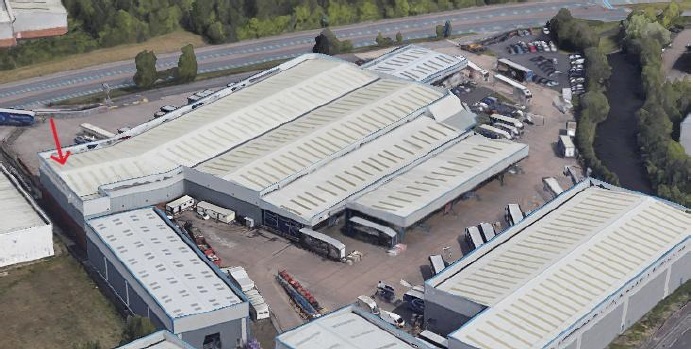
We wish to procure a roof-mounted solar PV System for the Engie supplied part of our site, as described below.

Electricity Consumption and System Size

An Energy assessment has been undertake for Sheldon Clayton by Pro Enviro. It Identifies that the annual energy consumption for the Engie-supplied part of Sheldon Clayton’s site was 320,116kWh in the year 21st June 2025 (228,778kWh day time and 91,338kWh night time); half-hourly data is available. Pro Enviro calculated out daytime rate as 21.239p/kWh and our night-time rate as 15.441p/kWh. For the purpose of calculating forecast return on investment, an export tariff of 8p/kWh should be assumed.

We are seeking quotes for the supply and installation of a solar PV system with a capacity of between 200 and 250kWp. We do not require battery energy storage to be included within system proposals. A view of the roofs of our buildings that could be used for the fixing of solar panels is shown below and the electricity meter and electrical arrangements at the point of supply:


Tender Response Required

The quoted price should be valid for installation between November 2025 and February 2026.
Confirmation of the capacity to install the system between November 2025 and February 2026 and an indication pf the lead times required.
Estimates of return on investment / payback period.
Examples of your relevant experience in commercial solar panel installations.
Duration of guarantee for the solar panels and other main items of equipment.

The tender submission deadline is 12 noon Monday 13th October 2025

Sheldon Clayton will select the supplier based on an assessment of the technical quality of the system specification, quotation price / value and an assessment of the experience and reliability of the supplier.
Please email your tender response to claire.whitehurst@sheldonclaytongroup.co.uk .

For more information contact:
Claire Whitehurst
Group Finance Director
0121 521 5945

CHANGES TO HGV ROLLER BRAKE TESTING

From April 2025, the DVSA (driver and vehicle standards agency) will be enforcing updated guidance requiring operators to conduct more frequent brake tests for HGV vehicles. These guidelines mandate that a laden brake test assessment should  take place 4 times a year ( 3 on inspection 1 on MOT).

We are aware this puts extra pressure on businesses to maintain best practice, and we are here to help. Sheldon Clayton Group have the facility to conduct brake testing and are based centrally in West Bromwich. Our facility is fully equipped to perform a laden brake test on HGV Artic and Rigid vehicles.

The legislation is in place as effective braking is crucial in the safety and compliance of HGV vehicles, and it is the operator’s responsibility to ensure that vehicles are regularly tested and fall within the new legislation. The main benefit of this method of testing is that it replicates a real-world scenario of braking conditions, meaning more accurate results.

To ensure your fleet remain compliant to this legislation book with us or enquire about prices today by emailing solutions@sheldonclaytongroup.co.uk

For more information on this new legislation please use the link below.
Updated requirements for Laden Brake Testing – April 2025

Windsor Framework – May 1st 2025

The Windsor Framework will come into effect on the 1st May 2025

It is important to understand that these changes are mandated by the UK Government and all carriers are required to implement these new requirements.

We strongly recommend reviewing the comprehensive guidance provided by the UK Government and registering for a UKIMs number if applicable.

We have provided below, a basic outline of the requirements needed to send your goods to Northern Ireland depending on the type of movement:

BUSINESS TO CONSUMER MOVEMENT

No UKIMS number is required for B2C movements as long as you meet the following criteria:

  • The parcel is sent by a UK established business or individual
  • The parcel is sent to a consumer (Private Individual)
  • The parcels do not exceed the weight limit of 100kgs for 1 parcel, or 31.5kgs for each parcel in a multi parcel consignment
  • The goods are not subject to specific domestic or international law restrictions

**Please note that if your goods do not meet these criteria, you will need to send the parcels in line with the business to business parcel movements and will be required to register for a UKIMS number**

The carrier is responsible for submitting data into the SDES system for HMRC and you will be required to provide them with the following information (copy of sales invoice containing):

  • Exporters Details – Suppliers name and address, (Street, City & Postcode)
  • Importers Details – Name of private Individual, and address (Street, City & Postcode)
  • Total amount Invoiced – Total value of the goods
  • Number of parcels
  • Number of items contained in each parcel
  • Gross Mass – Total weight of each parcel
  • Description of the goods
  • Commodity Code – 6 digit commodity code required

BUSINESS TO BUSINESS MOVEMENT

If you are planning on sending parcels business to business then one of the parties MUST be authorised under the UK Internal Market Scheme to use the simplified processes – This is usually the sender or recipient of the goods.

You can find more information which will be useful in the ‘business to business parcel movements’ section in the link here – How to move parcels from Great Britain to Northern Ireland for parcel carriers – GOV.UK

You can sign up for UKIMS via the following link: 

https://www.gov.uk/guidance/apply-for-authorisation-for-the-uk-internal-market-scheme-if-you-bring-goods-into-northern-ireland

Correct Packaging Procedures

Packaging has and always will be a crucial aspect of the supply chain in ensuring the safe and efficient distribution of goods through the transport networks.

Effective packaging is often the key to smooth pallet distribution ensuring seamless movement of products from the warehouse to the end user. But what is best practice for packaging when it comes to pallet networks?

Proper packaging enables you to store and transport your items more effectively, regardless of their shape or fragility. The use of good quality pallets that are stable and undamaged is the foundation for keeping your products safe and minimizing the risk of damage, ultimately saving you money.

Another important factor to remembers is, distributors need to know specifics about the items they handle to ensure safe transportation and care. Your packaging can communicate whether items are fragile, require special handling, or must be stored within specific temperature ranges. By adding No stack cones or making your items un-stackable, this will also help if your items fragile or lightweight and require no heavy objects to be placed on top of the goods.

All goods must be accurately declared for sizes and weight. Sheldon Clayton Logistics standard pallet sizes are 1200mm x 1200mm x 2200mm and with a maximum weight of 1000kilo. If a pallet is bigger than this footprint or heavier than the weight specification, this must be accurately stated on the job to allow the correct space and weight allocation and ensure there are no delivery delays.

Ineffective packaging increases risks for staff. Products that come loose from pallets can create tripping hazards, cause physical damage, and waste time, leading to unnecessary expenses in the supply chain. With the right packaging, employees will be able to move, assemble, load, and unload more efficiently, resulting in greater flexibility and improved productivity.

Improperly packaged products are vulnerable to various environmental threats, such as extreme weather, falls from conveyor belts, and being dislodged by forklifts. Damaged goods can lead to several issues, including strained customer relationships, a damaged reputation, lost profits, and additional costs. To ensure every product is fully protected, packaging must be both flexible and sturdy. With the right packaging, you can safeguard your products and avoid losses during inventory, maintaining your reputation.

We at Sheldon Clayton Logistics, have been handling pallets for almost 50 years and are a part of Pallet Track, one of the leading Pallet Networks in the country who handle pallets more often than a person can blink in a day, meaning your goods are in safe, capable hands.

Contact us today to find out how we can assist you. If you have any questions, our team members would be happy to help, so feel free to reach out.

Coming Soon: Roller Brake Testing (RBT)

Sheldon clayton group are currently in the process of installing our brand-new Roller Brake Testing Facility (RBT).

A roller brake test allows you to see a visual representation of the performance of your brake system under stationary and controlled conditions. What this means is that your braking force for each individual wheel, any imbalances across the axles, the testing of emergency brakes, parking brakes and a display of the vehicles brake force over time can be visualised, examined and tested. The roller brake test will also help to stop any costly problems from occurring when you are on the road.

Under the new legislation, all commercial vehicles or trailers are recommended to complete four successful brake efficiency tests over the course of the year, comprising of the vehicles annual MOT test and three additional brake efficiency tests. At Sheldon Clayton, we are fully equipped to perform roller brake testing as a standalone service for local fleet operators and mobile mechanics.

When performed by a member of our team, brake testing allows our technicians to calculate the exact level of performance of your brake system and diagnose any faults found within, efficiently pinpointing the area that needs to be serviced to get you safely back to work. All roller brake testing work is carried out on site in West Bromwich, allowing us to perform all tests in a static and safe manner with no adverse weather effects to be taken into consideration. Once the test is completed, you will be provided with the measurements and results for each individual wheel, allowing you a more in-depth look and understanding at the diagnosis of any issues as well as being able to see what, if any, work needs to be done to get the vehicle roadworthy again.

Contact us to find out more

Benefits of a Pallet Network

Benefits of a Pallet Network

In today’s fast-paced logistics and supply chain environment, businesses are constantly looking for ways to streamline operations and reduce costs. One solution that’s gaining popularity is pallet networks, which offer a lot of advantages for companies needing to move goods efficiently and affordably. Whether it’s speeding up delivery times or lowering their environmental impact, pallet networks are changing the game for how businesses handle shipping.

What is a pallet network?

Pallet networks use a hub and spoke distribution model to collect, sort and deliver goods around the country. Network members are located nationwide and are allocated a postcode area from which they collect and deliver palletised goods.  This setup lets companies share transport space, cutting down shipping costs while speeding up delivery times and expanding their reach.

Some of the key benefits:

1. Cost Efficiency

One of the biggest advantages of a pallet network is the cost savings. Instead of paying for a full truckload, businesses can share space with others, only paying for the pallet space they use. This “shared load” approach reduces transport costs, especially for companies shipping smaller quantities of goods. By consolidating shipments, pallet networks also cut down on empty vehicle journeys, further reducing fuel costs and the overall cost per pallet.

2. Faster and More Reliable Deliveries

Pallet networks often have well-established infrastructure with multiple regional depots and hubs. This setup means that goods can be quickly sorted and sent to their destination, often achieving next-day or two-day delivery. Businesses benefit from more predictable and timely deliveries, which is especially important in today’s e-commerce-driven market, where customers expect fast service.

3. Nationwide Reach

With a network of hauliers covering different geographic regions, businesses can access a wider delivery area through a pallet network than they might be able to on their own. Many pallet networks operate nationally, allowing businesses to expand their customer base and easily ship to distant locations without the need to set up new logistics infrastructure.

4.  Environmental Benefits

By consolidating loads and reducing the number of vehicles on the road, pallet networks help lower carbon emissions and reduce the environmental impact of transportation. Fewer trucks mean less fuel consumption and lower emissions, which is increasingly important as businesses focus on sustainability and meeting environmental goals. Many pallet networks also optimise routes to ensure maximum efficiency and minimal waste.

5.  Scalability and Flexibility

For businesses with fluctuating shipping volumes, pallet networks provide a flexible solution. Whether a company needs to ship a single pallet or several, the network can easily scale to accommodate the demand. This flexibility allows businesses to respond to seasonal spikes or sudden increases in orders without worrying about hiring additional transport or warehousing.

6.  Improved Tracking and Visibility

Most pallet networks offer advanced tracking systems, giving businesses real-time visibility over their shipments. This transparency allows companies to monitor the location of their goods at every stage of the journey, providing customers with accurate delivery estimates and improving overall customer satisfaction. Tracking also helps businesses identify and resolve any issues that arise during transport, ensuring smoother operations.

In an era where efficiency, cost management, and sustainability are key, pallet networks provide an effective solution for businesses looking to optimise their logistics. The ability to share transport resources, access a wide delivery network, and reduce environmental impact are just some of the reasons why pallet networks are becoming the go-to option for companies of all sizes. By embracing this model, businesses can improve their logistics operations, cut costs, and meet the growing demands of a competitive market.

Navigating Customs

Since Brexit in 2020, shipping goods internationally has become a lot more complicated. The once easy process had become somewhat of a minefield, which can be pretty intimidating for anyone looking to continue shipping overseas.

Our in house team has been handling Irish, Offshore and international shipping since the very beginnings of the Sheldon Clayton group. They keep with the latest rules and details of shipping so that you don’t have to worry about the hassle. Our aim is to make the whole process as smooth as possible for our customers.

What are Customs?

Customs are the individuals who handle the ins and outs of international trade. They make sure all the rules for importing and exporting goods are followed, collect tariffs and taxes, and check that everything meets local regulations and standards. Customs officers are essential for keeping national security, public health, and the economy safe and sound.

Key Documents for Customs Clearance

Navigating customs clearance is now one of the most crucial aspects of international shipping. To help our clients, the Sheldon Clayton Group ensures that all necessary documents are meticulously prepared and submitted. Some of the primary documents required include:

  1. Commercial Invoice: This document is essential as it provides details of the transaction between the seller and the buyer, including the value, description, and quantity of the goods being shipped.
  2. Packing List: This complements the commercial invoice by offering detailed information about the contents of each package, including weight and dimensions, ensuring accurate customs inspection and clearance.
  3. Customs Declaration: A mandatory submission that includes comprehensive details about the shipment, helping customs authorities to assess and process the shipment accordingly.
  4. Direct Representation Form: Direct Representation is a specific type of authorisation where a customs broker or agent acts on behalf of an importer or exporter. The form allows the broker to submit customs declarations in the name of and on behalf of the importer or exporter.

Key Elements of Customs Procedures

  1. Documentation: Accurate and complete documentation is critical. This includes invoices, packing lists, certificates of origin, and any required licenses or permits. Proper documentation ensures compliance and facilitates the customs clearance process.
  2. Classification of Goods: Goods are classified using the Harmonised System (HS) codes, an internationally standardised system of names and numbers. Correct classification is essential for determining applicable duties and taxes.
  3. Valuation: The value of the goods must be declared correctly for the assessment of duties and taxes. This includes the cost of the goods, insurance, and freight (CIF value).
  4. Customs Declarations: Importers and exporters must submit detailed declarations to customs authorities, providing information about the goods being traded. This can often be done electronically through customs systems.
  5. Inspection and Release: Based on risk assessment, customs authorities may inspect shipments to verify the accuracy of declarations and compliance with regulations. Once cleared, goods are released for delivery.

At Sheldon Clayton Logistics, we get it—shipping internationally has gotten a lot trickier since Brexit. But don’t worry, we’ve got your back. Our team stays on top of all the latest rules and regulations, so you don’t have to. By making sure every shipment meets the new requirements, we help you avoid delays and extra costs, letting you focus on what you do best. With us, you can be confident that your international shipping is in good hands.

Sheldon’s get Platinum Award at Pallet Track Gala

Sheldon Clayton Logistics has collected an award for its contribution to the logistics industry.

We have been named Platinum Award Winners by Pallet-Track following a successful year in business at an event hosted by TV favourite and DJ Vernon Kay.

The award was for the business’ contribution to the national Pallet-Track network, which enables independent hauliers to work together to transport freight efficiently around the UK which we have been a shareholder member for over a decade.

We picked up the accolade at Pallet-Track’s 20th anniversary shareholder gala, which was held at the De Vere Beaumont Estate in Windsor.

Scott Campbell, MD, said: “We are so pleased to be recognised for our contribution to Pallet-Track and we are proud of our team’s hard work and continued success.

“As an industry, we have faced real challenges in recent years, so it is fantastic to receive recognition and to have an opportunity to celebrate our collective achievements.

“We look forward to building on our success in the year ahead.”

Stuart Godman, chief executive of Pallet-Track, said: “Congratulations to COMPANY NAME on their award, which is well deserved, and their ongoing contribution to the Pallet-Track network.

“Our shareholder gala provides a welcome opportunity to celebrate our network members who have gone the extra mile time and again during the last 20 years.”

Fuel Surcharge – Current Costs & Info

In the current economic climate we are witnessing volatile changes to fuel prices. To protect our customers from constant fluctuations in their transport rates, in June 2009 we started adjusting our fuel surcharge every month based on the average of the previous month’s costs. The majority of rate schedules are set on a base price pence per litre + VAT. When the fuel price passes the base price a fuel surcharge kicks in.

For anyone who distributes goods on a daily basis, fuel prices have direct cost implications on the transport movement. Fuel now represents up to 9% of Sheldon Clayton Logistics turnover as we use over 1 million litres per year.

You may think that Sheldon Clayton Logistics, as a company, should absorb all these increased costs. This however would mean we would have to reduce the amount we spend on being able to offer the high level of service that our customers have come to expect from us.

What we can do is ensure customers understand the implications for future haulage costs, so that they can budget realistic figures. We have tried to keep fuel surcharge to a minimum across the years see below for current and previous fuel charges applied by Sheldon Clayton :

DATE PRICE 
01 January 2022112.46
01 February 2022118.34
01 March 2022123.00
01 April 2022144.82
01 May 2022142.76
01 June 2022141.36
01 July 2022159.65
01 August 2022146.44
01 September 2022150.31
01 October 2022141.94
01 November 2022152.09
01 December 2022132.19
01 January 2023129.37
01 February 2023131.68
01 March 2023119.79
01 April 2023115.22
01 May 2023107.23
01 June 2023109.23
01 July 2023112.79
01 August 2023121.15
01 September 2023126.76
01 October 2023125.09
01 November 2023125.09
01 December 2023119.03
01 January 2024114.48
01 February 2024114.48
01 March 2024118.75
01 April 2024117.36
01 May 2024117.36
01 June 2024115.32
01 July 2024114.36
01 August 2024114.36
01 September 2024111.48
01 October 2024107.04
01 November 2024106.87
01 December 2024110.28
01 January 2025110.06
01 February 2025113.00
01 March 2025113.07
01 April 2025110.82
01 May 2025109.55
01 June 2025109.55
01st July 2025109.55
01st August 2025111.35
01st September 2025110.27
01st October 2025110.40
01st November 2025110.25
01st December 2025113.75
01st January 2026109.85
01st February 2026109.05
01st March 2026109.51
01st April 2026138.05
01st May 2026143.48
01st June 2026138.08
01st July 2026130.06
01st August 2026132.5
01st September 2026143.28
01st October 2026156.71